
This is the question that separates basic solar setups from proper whole-home systems. Many installers in Rivers State will tell you solar cannot handle an AC, or they'll give you an undersized system that cuts out the moment you switch it on. Both are wrong.
Solar can absolutely power an AC. The system just has to be built for it.
Why AC Units Are Demanding on Solar
An air conditioner has two power demands you need to account for:
Starting (surge) current: When a compressor starts, it draws 3 to 6 times its running wattage for 1 to 3 seconds. A 1.5HP AC with a 1,300W running load may pull 4,000 to 5,000W at startup.
Running load: The continuous power draw while the AC is operating. This is the figure on the spec sheet.
If your inverter cannot handle the startup surge, it will trip or alarm every time the AC cycles on. This is the most common complaint from people who bought undersized systems elsewhere.
AC Wattage Reference by Size
| AC Size | BTU Rating | Running Watts | Startup Surge |
|---|---|---|---|
| 1HP split AC | 9,000 BTU | 750 -- 900W | 2,500 -- 3,500W |
| 1.5HP split AC | 12,000 BTU | 1,100 -- 1,500W | 3,500 -- 5,000W |
| 2HP split AC | 18,000 BTU | 1,800 -- 2,200W | 5,000 -- 7,000W |
| 2.5HP split AC | 24,000 BTU | 2,200 -- 2,800W | 6,500 -- 8,500W |
Inverter AC vs conventional AC: Inverter-type air conditioners (most modern units from LG, Samsung, Haier, Daikin) have variable-speed compressors that reduce the startup surge significantly and run more efficiently at partial load. If you're buying a new AC to pair with solar, always choose an inverter-type unit.
What System Do You Need for One 1.5HP AC?
Here is the minimum specification for reliably powering one 1.5HP split AC in Port Harcourt along with basic home loads (lights, fans, TV, fridge):
| Component | Minimum Spec | Recommended Spec |
|---|---|---|
| Solar panels | 3kW (7 × 450W) | 4kW (9 × 450W) |
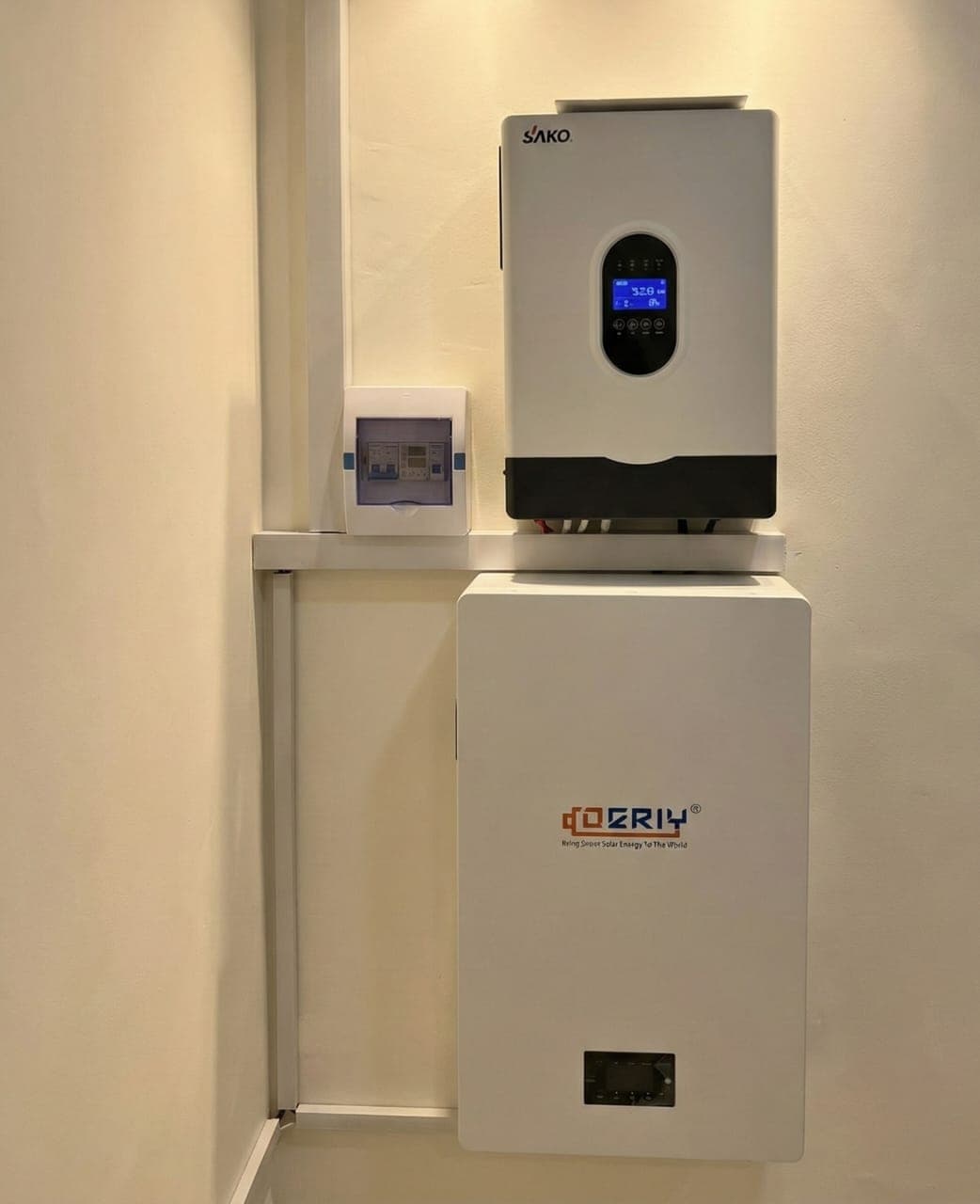
| Inverter | 5kVA pure sine wave | 5kVA -- 8kVA pure sine wave |
| Battery bank | 48V 200Ah LiFePO4 | 48V 300Ah LiFePO4 |
| Charge controller | Built into hybrid inverter | Built into hybrid inverter |
The 5kVA inverter is necessary even though the AC's running load is only 1,300W. You need headroom for the startup surge plus the other loads running simultaneously.
What System for Two AC Units?
Two 1.5HP ACs running simultaneously (e.g. living room + master bedroom at night) requires:
| Component | Specification |
|---|---|
| Solar panels | 6kW to 8kW |
| Inverter | 8kVA to 10kVA pure sine wave hybrid |
| Battery bank | 48V 400Ah to 500Ah LiFePO4 |
At this scale, the system cost in Rivers State is typically ₦7,000,000 to ₦11,000,000 fully installed. The payback period remains under 18 months given the fuel cost savings.
The Overnight AC Problem
The most common challenge: people want to sleep with AC running all night but panels only generate power during daylight.
Here is the math for overnight AC use:
1.5HP AC running 8 hours overnight = 1,300W × 8h = 10,400Wh
Other overnight loads (fridge, lights) = ~1,500Wh
Total overnight battery requirement = ~12,000Wh

LiFePO4 at 80% DoD: 12,000Wh ÷ 0.8 = 15,000Wh bank needed
= 48V 312Ah (round up to 400Ah for comfort)
Your panels then need to fully recharge that bank during the day while also powering daytime loads:
15,000Wh to recharge + 5,000Wh daytime loads = 20,000Wh from panels
At 4.5 Port Harcourt PSH with 80% efficiency: 20,000 ÷ (4.5 × 0.8) = ~5,600W panels
Conclusion: Running one 1.5HP AC overnight reliably requires roughly 6kW of panels and a 400Ah LiFePO4 battery bank. This is a real number. Anyone quoting you 2kW panels for an AC system is undersizing your installation.
Inverter AC vs Conventional: The Solar Difference
If you're buying a new AC to pair with solar, this decision matters a great deal.
| Feature | Conventional AC | Inverter-Type AC |
|---|---|---|
| Startup surge | High (3-6x running watts) | Low (1.2-2x running watts) |
| Efficiency at partial load | Poor | Excellent |
| Suitable for solar | Requires larger inverter | More solar-compatible |
| Energy saving vs conventional | Baseline | 30 to 50% less consumption |
| Recommendation | Not ideal for solar | Always choose this for solar |
An inverter-type 1.5HP AC can consume as little as 800 to 900W in steady operation versus 1,300W+ for a conventional unit. Over 8 hours nightly, that's a 3.2kWh difference — enough to reduce your required panel and battery size meaningfully.
Common Mistakes When Adding AC to a Solar System
Buying a system without AC in mind, then trying to add it later. The inverter may not have the surge capacity. The battery bank is too small. You end up replacing components that were already installed.
Choosing the cheapest inverter. Modified sine wave inverters damage AC compressors. Undersized inverters trip on startup. The inverter is not where to cut costs.
Not accounting for harmattan and rainy season. Port Harcourt's rainy season (April to October) means more cloud cover and fewer peak sun hours. Size for this, not just the dry season ideal.
Running multiple high-surge loads simultaneously. AC startup + pump startup + fridge compressor cycling at the same moment can trip even a well-sized inverter. Use staggered starts where possible.
The Bottom Line
Solar can power your AC in Port Harcourt. It requires:
- A pure sine wave hybrid inverter rated at least 5kVA (for one 1.5HP AC)
- Enough panels to cover daytime loads AND overnight battery recharge (typically 4kW to 6kW for one AC home)
- A LiFePO4 battery bank sized for the overnight hours you want covered
- An inverter-type AC unit if you're buying new
Cutting any of these corners results in a system that either can't start the AC or runs out of power at midnight.