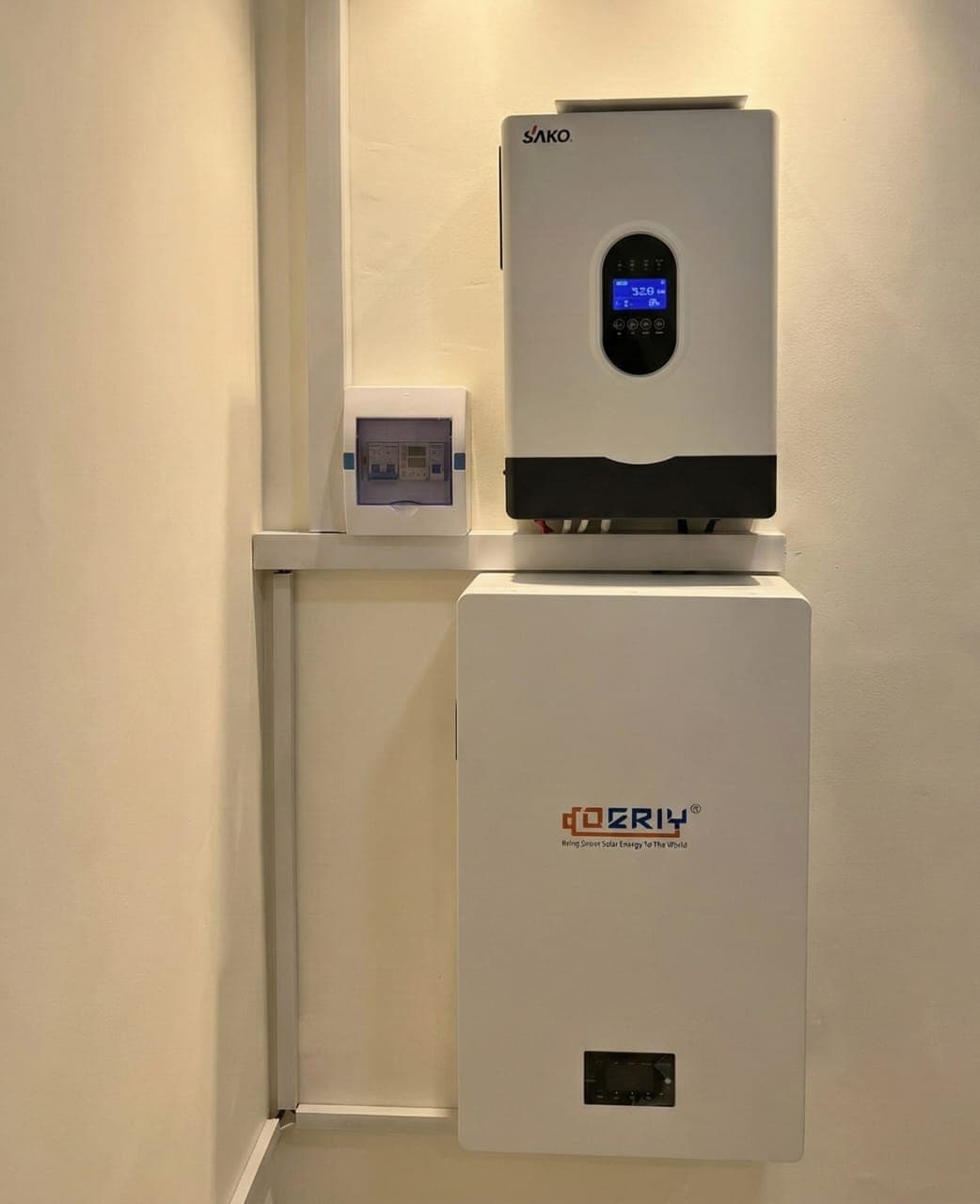

Every solar battery system runs at a set voltage. The common ones are 12V, 24V and 48V. The right one depends on how big your system is.
The simple rule
| System size | Best voltage | Example use |
|---|---|---|
| Up to about 1kVA | 12V | A room: lights, fan, phone |
| About 1.5kVA to 3kVA | 24V | Small flat, no AC |
| 5kVA and above | 48V | Family home, AC, pump, office |
Why higher voltage is better for bigger systems
Power = voltage × current.
To deliver 3,000W:
- At 12V, you need about 250 amps.
- At 24V, about 125 amps.
- At 48V, about 63 amps.
Big current needs very thick cables. It also makes heat, and heat wastes power. At 48V, the current is low. Cables are thinner and cooler. Less power is lost.
Why 48V is now normal
- Most 5kVA, 6kVA and 10kVA hybrid inverters are 48V.
- Most home lithium batteries are 48V (labelled 51.2V).
- 48V is easy to grow. You can add another battery later.
Our 6kVA family system in Port Harcourt and Asaba runs at 48V.
When 24V is fine
A small 3kVA system for a one or two-bedroom flat can work at 24V. If you might add an AC later, start at 48V instead. Read 3kVA vs 5kVA.
A safety note
Do not mix batteries of different voltages. Do not connect a 24V battery to a 48V inverter. Always follow the inverter's voltage.