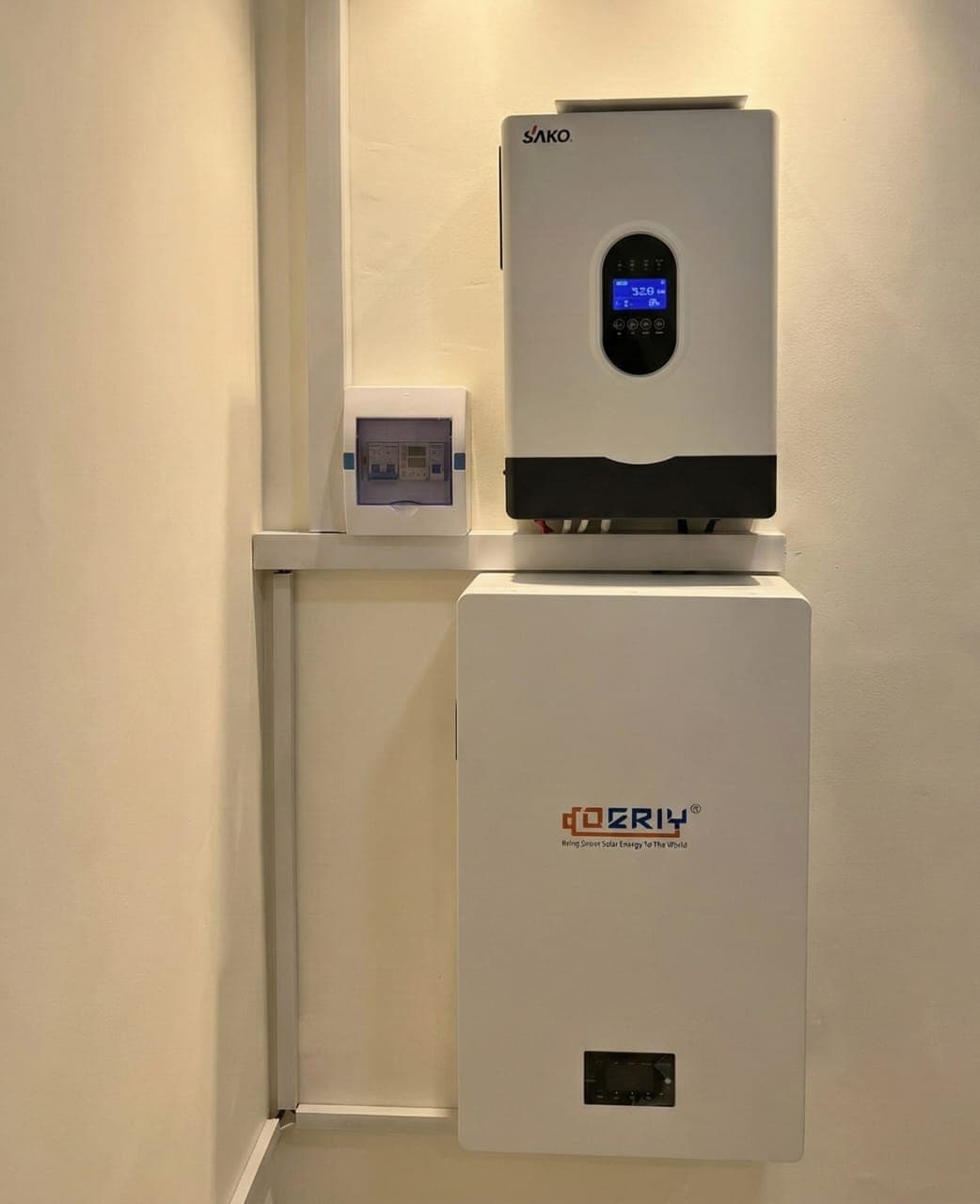

Every installer uses these three words differently, so here they are in plain terms, and which one makes sense for homes on PHED supply in Port Harcourt and Yenagoa or BEDC supply in Warri and Asaba.
The three types at a glance
| Hybrid | Off-grid | Grid-tied (no battery) | |
|---|---|---|---|
| Batteries | Yes | Yes | No |
| Uses grid power | Yes, to charge and supply loads | No (or only as backup) | Yes |
| Works during outages | Yes | Yes | No |
| Can use a generator | Yes | Yes | No |
| Best for | Most homes and businesses | No-grid or very poor-grid areas | Places with near-24-hour grid |
Hybrid solar: the default choice for most homes
A hybrid inverter takes power from three places (the sun, the grid and a generator) and decides what to use first. Typically it runs your home on solar during the day, charges the batteries with spare solar, uses grid power when it is available, and switches to the batteries at night or during outages.
Why it matters in Nigeria: if you get even four to six hours of grid supply, those hours can top up your batteries. That lets you buy a smaller (cheaper) battery bank for the same reliability. It also means a long run of cloudy days in the rainy season is not a crisis.
Best for: most homes in Port Harcourt, Obio-Akpor, Asaba, Warri and Yenagoa.
Off-grid solar: when there is no grid to lean on
An off-grid system is designed to run entirely on solar and batteries. It needs a bigger battery bank and more panels because there is nothing else to fall back on (except, optionally, a generator).
Best for: island and riverine sites like Bonny and Brass, new estates without a transformer, farms and remote sites.
In practice, most "off-grid" inverters sold in Nigeria are hybrids that can accept grid input later, so you are not locked in.
Grid-tied solar: why it rarely fits Nigeria
A grid-tied system sends solar power straight into your home's supply with no battery. For safety, it must switch off when the grid goes down, so your solar stops exactly when you need it. Unless your area gets close to 24-hour supply, this is the wrong system.
What about "inverter only" with no panels?
That is an inverter and batteries charged only from the grid. It is not a solar system, and in areas with few grid hours the batteries rarely charge fully and die early. We explain why in inverter only vs full solar.
Which should you choose?
- Some grid supply, budget-conscious: hybrid with a modest battery
- Very little grid, want silence at night: hybrid with a larger battery
- No grid at all: off-grid with generous panels and storage
- Business with critical loads: hybrid, with the generator connected as a last resort
Whatever you pick, insist on a pure sine wave inverter. Here is why it matters for your AC and fridge.
See what each size costs on the pricing page.